Case study · Lender edition · Chassis ending 1076
The manual that wasn’t.
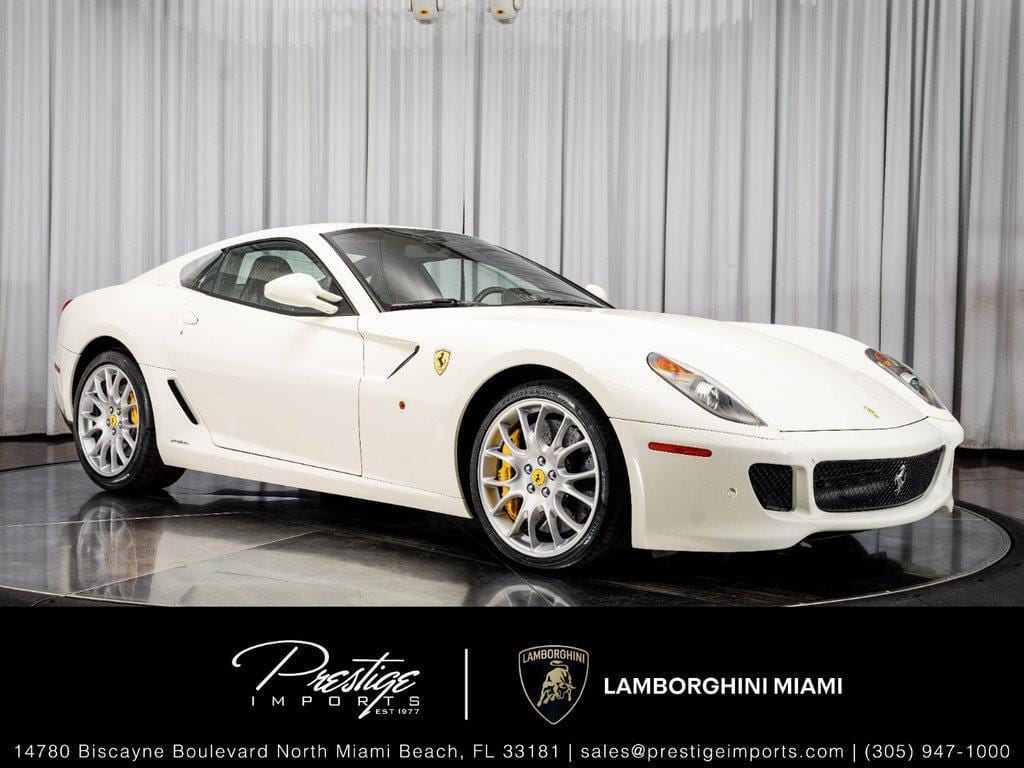
A 2011 Ferrari 599 GTB on a dealer floor at $449,950. A lender who wanted a second opinion before the money moved. And four photographs, in the seller’s own gallery, worth a third of a million dollars.
01 · The car
A white 599 asking
manual money.
The car itself is easy to want. A late-production 2011 599 GTB Fiorano in Bianco Avus over Nero, 12,547 miles, five of its first years serviced inside the Ferrari franchised network, a clean title in every state it ever touched. Jason Castriota’s bodywork for Pininfarina has aged into something between sculpture and threat. On a South Florida showroom floor, in white, it photographs like money.
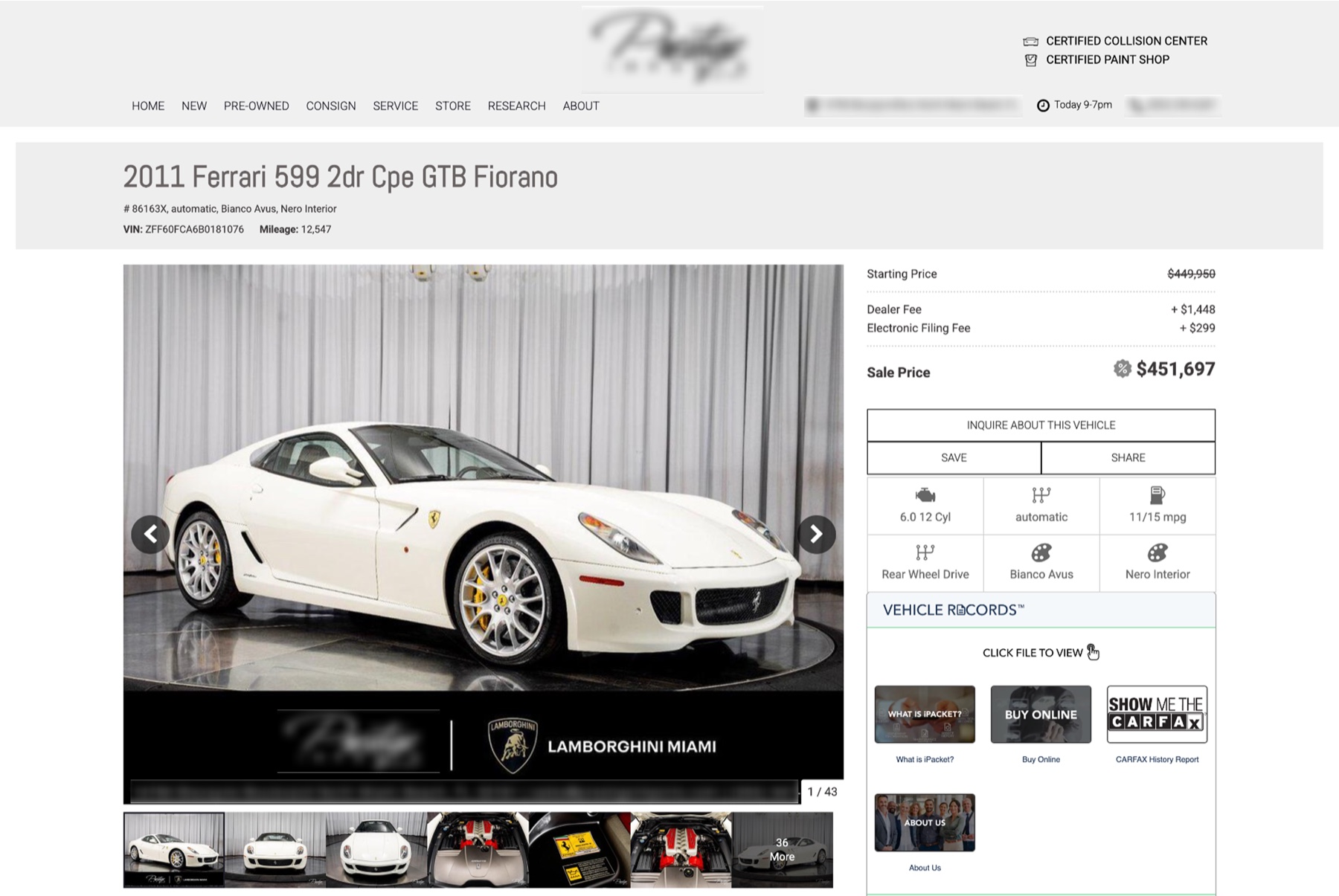
The ask was $449,950. With dealer and filing fees, $451,697 to the wire.
Somewhere behind that number, a lender wanted a second opinion before a wire went out. The commission arrived the way these commissions do, quietly and with a deadline, carrying the only question that matters before funds move: what does the record say this car is actually worth? Not the listing. Not a price guide. The record: every verified sale of every comparable car, read against this exact chassis.
That commission became a full dossier and a lender-edition Collateral Brief. This page is the story of what the file found, with every party left unnamed. The point of the case study is the pattern, not the players.
02 · Two cohorts
Two cars share
one body.
Ferrari built the 599 GTB with two transmissions. Roughly 95 percent of the run took the F1 SuperFast, a single-clutch automated gearbox shifted by column paddles. The remainder, about thirty cars worldwide, twenty of them for North America, got a gated six-speed manual. Same body, same V12, same badge.
The market does not treat them as the same car. Across seven sales with published auction records, the factory manuals have traded between $409,000 and $830,000. The F1 cars, the cohort nearly every 599 belongs to, trade between $90,600 and $368,000, with realistic money clustered near $150,000.
Here is the trap, and it catches real buyers: search this model’s auction results and the headlines are the manual records. Eight sales out of hundreds set the public’s idea of the price. A buyer who prices a 599 off those headlines, or a seller who lets them, is off by a factor of three before anyone opens the driver’s door.
Factory six-speed manual
~30 built · 7 verified sales
$409,000 – $830,000
F1 SuperFast
~95% of production
$90,600 – $368,000
This car’s ask
Dealer fixed price
$449,950
Every verified sale in the file
The ask clears both cohorts. Including the newest manual sale in the world.
Twenty-one verified transactions from RM Sotheby’s, Bonhams, Gooding, Broad Arrow, Mecum, Collecting Cars, and Iconic Auctioneers. The red line is the ask. Hover or tap any dot to see the car, and open it for that lot’s own published record. Every sale is listed underneath as well, because in the F1 cluster the dots sit closer together than a fingertip. Every one of them goes somewhere you can check.
03 · The tell
The listing disagreed
with itself.
The listing’s specification block called the transmission automatic. Forty lines down, the same page’s equipment list opened with “6-speed manual transmission.” On most cars that contradiction is trivia. On a 599 it is a swing of a quarter million to six hundred and fifty thousand dollars, and the ask only makes sense if you believe the second line.
The fairest reading, and probably the true one, is that the equipment list is catalog boilerplate: a data feed describing the model’s base configuration, not this chassis. The file found the identical phrase, word for word, on the same dealer’s listing for a different 599 under a different VIN. Nobody has to have intended anything for a line like that to do damage. It sits there, load-bearing, under a $449,950 price.
A VIN decode cannot settle a 599’s gearbox. Ferrari’s own decoding chart, the one filed with the federal government, spends its seventeen characters on model type, engine, restraints, market, year, plant and sequence; transmission is not among them, and a live decode of this VIN returns no transmission field at all. The CarFax in the file did not carry one either. The document that answers it outright is the factory window sticker, and no window sticker was in the listing. So the question came down to evidence anyone could have checked: four photographs, published with the ad.
04 · The evidence
The seller’s own gallery
answered the question.
No inspection, no site visit, no seller cooperation required. The four photographs that settled a $300,000 question were published with the listing itself.
What closed it was not a person squinting at a gallery. Molly’s condition agent ran a vision pass over every published frame, reading the cabin against a model-specific checklist: what a gated 599’s tunnel, tachometer and footwell must show, and what an F1 car cannot hide. Four frames came back decisive, and each finding was written into the evidence file as a claim pinned to its exact image.
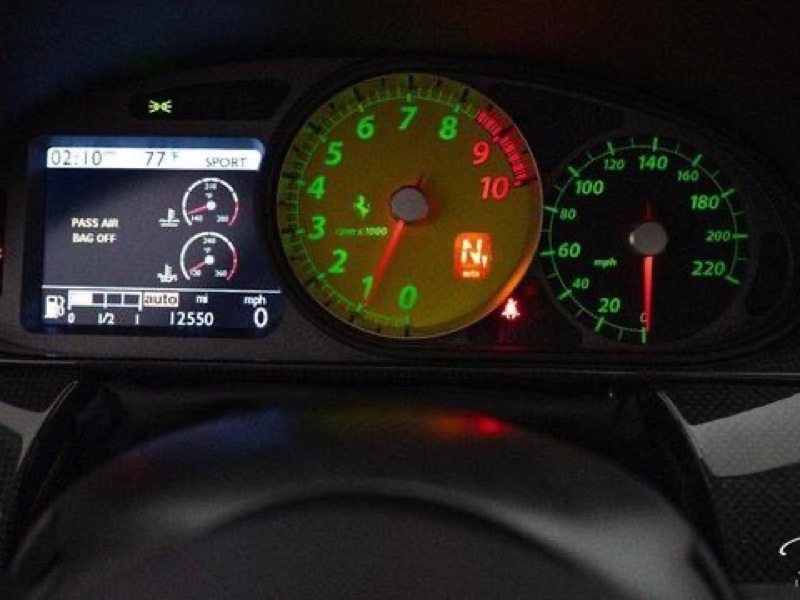
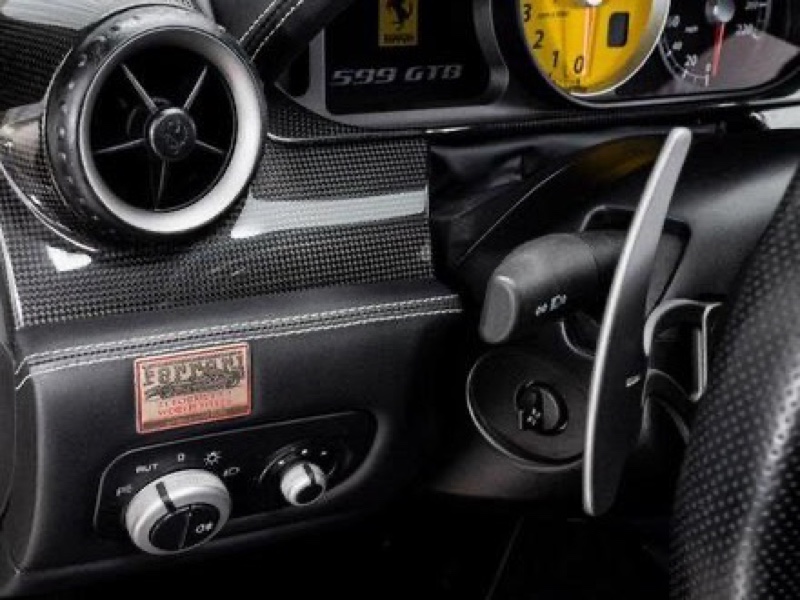
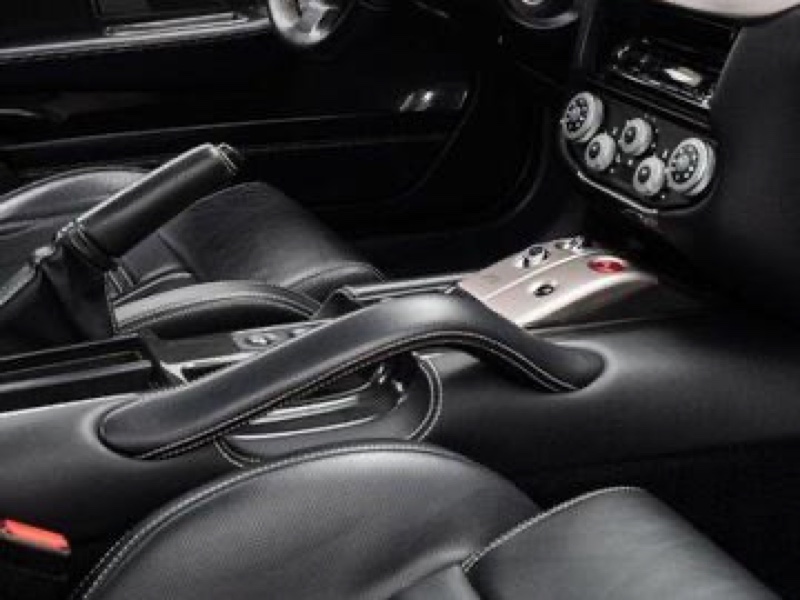
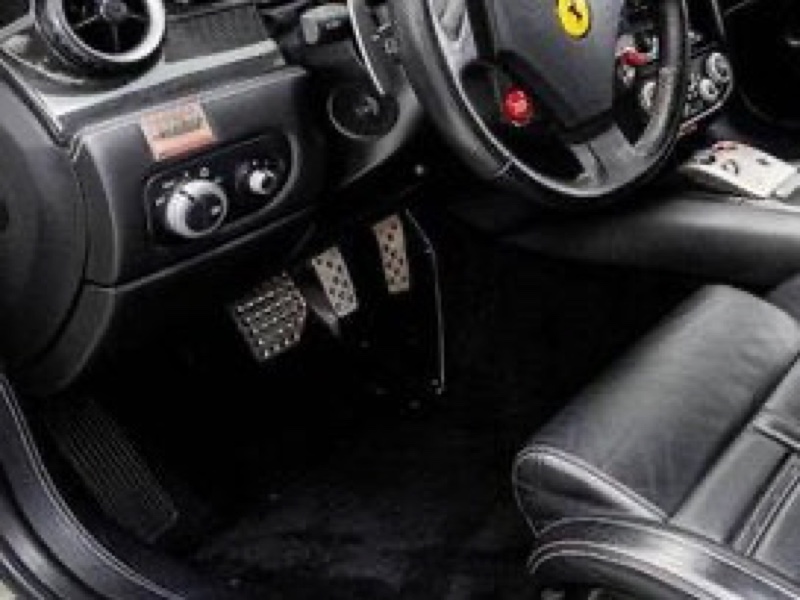
The paddle sits right where the gate should be.
From the dossier, July 2026
05 · The number under the number
Same car. Sixty-three miles.
Twice the price.
The sharpest number in the file was not a comp. It was this exact VIN, offered by a different Florida dealer in October 2024 at $209,997, with 12,484 miles showing. Twenty-one months and sixty-three miles later, the same chassis was asking $449,950. A 114 percent increase on no meaningful use, no fresh documentation, and no market movement that could carry it: the F1 cohort’s own trendline runs down 2.9 percent a year.
From there the appraisal is arithmetic, and every line of it is a deduct. The anchor is the closest verified sale in the world: a 2011 F1 car, 4,761 miles, the desirable HGTE handling package confirmed, sold at Collecting Cars in December 2025 for $149,000. A better car than the subject on every documented point. Adjust it honestly for this car’s higher mileage, unconfirmed options, a four-year service silence, and six owners in fifteen years, and the defensible range lands at $75,000 to $114,000.
One more test bounds the ceiling from above. In November 2025 a 2010 F1 599 with HGTE and carbon-ceramic brakes confirmed, at similar mileage, a stronger car on paper in every way, failed to meet its reserve at auction. If that car could not find its money, this one was not going to find $449,950.
From anchor to appraisal
| Anchor sale, Dec 2025, HGTE, 4,761 mi | $149,000 |
|---|---|
| Mileage, 12,547 vs 4,761 | −$8,000 to −$15,000 |
| HGTE package unconfirmed | −$10,000 to −$20,000 |
| Storage recommissioning | −$4,000 to −$9,000 |
| F1 pump and clutch, unmeasured | −$4,000 to −$12,000 |
| No build sheet, service silence | −$5,000 to −$10,000 |
| Six owners in fifteen years | −$4,000 to −$8,000 |
| Supportable range | $75,000 – $114,000 |
No premium is applied anywhere in the table. Credits wait for the document that proves them.
The distance between the ask and the record
$335,950 of the ask has no verified sale behind it. Not in the F1 cohort. Not in the manual cohort either.
06 · The Collateral Brief
What the lender read
before the wire.
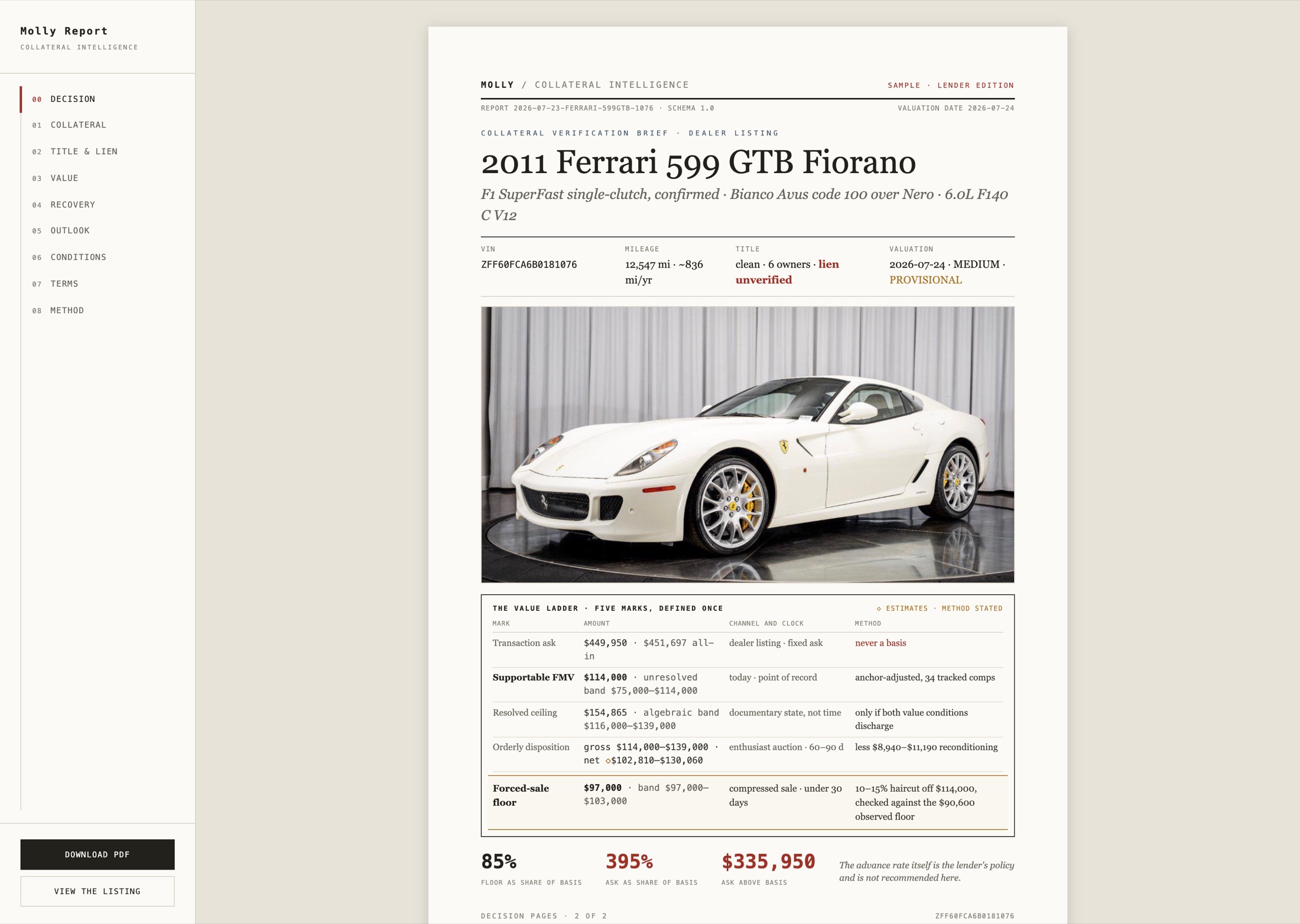
The client’s deliverable was not a verdict on whether to love the car. It was a Collateral Brief: the dossier’s findings restated for an underwriter, with a supportable value basis, a forced-sale floor with a stated method, and the conditions that had to clear before funding. The brief recommends no advance rate and no structure. It exists so the lender’s own policy has a defensible number to operate on.
Its center of gravity was one sentence: advance against the $114,000 the record supports, not the $449,950 the listing asks. A loan sized against the ask, at any advance rate a policy would bless, puts more money on the road than the car could return at auction the same week. Sized against the record, the same loan survives its own collateral.
- Flood check before funding. The history file goes silent for 46 months while the car sat in a county that took a record flood. A clean title does not close that window; an inspection and an insurance-claims pull do.
- Odometer reconciliation. Two readings in the record run backward by 772 miles. Explainable, but not yet explained.
- The build sheet. One document confirms the options worth up to $20,000 of upside. It had not been produced.
- Clutch and pump diagnostics. The F1 gearbox’s two known wear items, never measured in the car’s documented life.
07 · Where it landed
The verdict was Overpay. Not because the car is bad. Because the ask clears every verified sale of every comparable car on earth, in either gearbox, and the file could prove it.
Verdict tier · bid to $114,000 · walk away above $154,865
Drawn to scale. Every verified F1-cohort sale on earth lands in the first three bands. The ask sits alone, at the far end of a stretch nothing has ever sold in.
08 · Four desks
One file.
Four ways to read it.
The research engine does not get smaller for anyone: every report runs the same full evidence swarm, the same comp ledger, the same appraisal arithmetic. What the reader changes is where that engine aims. Tell Molly the file is going to an underwriter and the research plan comes back downside first, with the forced-sale floor ahead of the retail midpoint, title attachability and lien position broken out as their own line of inquiry, and the seller’s standing named and sourced rather than assumed. Tell her it is a collector and the same engine presses hardest on originality, documentation, and the options that survive a resale. Then the writing follows the aim: which number leads, which risk surfaces first, what the reader is told to do next. What never moves is the finding.
A credit desk is not buying the car; it is buying the risk. This reading leads with the supportable basis, $114,000, prices every unknown as a deduct, and sets out the conditions that must clear before funding. The prose drops the romance entirely and writes in the flat, sourced register an underwriter can lift straight into a credit file.
The number that leads
$114,000
supportable collateral basis
A collector is not underwriting a worst case; they are deciding what the car is worth to them. Some buy as an investment, most buy out of passion, and the report leaves room for that. It leads with the fair-value band the record supports, then draws the line where the flexibility ends: above $154,865, the file says you are no longer paying for the car. You are paying for the story.
The number that leads
$154,865
the walk-away line · where even passion stops
A dealer thinks in spread, so this reading is built like a wholesale sheet. It leads with the acquisition cap, models a realistic exit through the channel where this cohort actually trades, and prices the recommissioning stack into the buy rather than the retail ask. No romance, no adjectives, just the trade.
The number that leads
$25,000
buy-to-exit spread, build sheet in hand
An insurer needs numbers nobody else asks for: an agreed value that will hold at claim time, and what a specialist repair actually costs. This reading leads with the agreed-value band and the repair-cost drivers, and flags the documentation gaps an underwriting file would want closed before binding.
The number that leads
$28,190
specialist repair exposure, worst case
When the client is a lender, the tailoring goes one step further: the whole dossier is rewritten as the eleven-section Collateral Brief in section six above, ordered the way an underwriter reads. It still recommends no advance rate and no loan structure. That call belongs to the lender’s policy, and a research file that quietly made it for them would be worth less, not more.
09 · Method
Real numbers,
first sources.
Nothing on this page leans on a third-party price guide or a borrowed valuation feed. Every figure traces to a primary record: the auction house’s own published result, the listing as it ran, the title and history file supplied with the commission. Each source in the dossier carries its URL and the date we read it, and the citation gate in our pipeline rejects any claim that cannot show one.
That is the discipline the case turned on. The manual premium is real, and the dossier proves it with eight sales. It just belongs to thirty cars, and this was not one of them. The gap between those two sentences was worth $335,950 to one buyer, on one car, on one Tuesday in July.
The record answers.
Ask it before the money moves.
Lenders: the Collateral Brief is a lender-edition deliverable built on the same dossier. Commission a report and say it is for a credit file, or write us directly.